Showing posts with label Carolyn Dobbin. Show all posts

Wednesday, 26 March 2025

Wagner - Der fliegende Höllander (Dublin, 2025)


Richard Wagner - Der fliegende Höllander

Irish National Opera, 2025

Fergus Sheil, Rachael Hewer, Jordan Shanahan, Giselle Allen, James Creswell, Toby Spence, Carolyn Dobbin, Gavan Ring

Bord Gáis Energy Theatre, Dublin - 23rd March 2025

After a number of ambitious productions in the seasons following their 2018 inauguration, it seemed to me that post-pandemic the Irish National Opera had settled down to productions that are a little less challenging and perhaps more accessible to a wider audience that might not regularly go to the opera. That would seem to continue to be the case with their latest production of Der fliegende Höllander, the most accessible of Wagner's works, although performing any Wagner opera can be seen as challenging enough really. While there was no extravagant contemporary reinterpretation of the meaning of the work or sign of any imaginative play on its themes, it can sometimes be enough just to let a 'respectful' production of Wagner's work speak for itself, and in the case of the INO's 2024-25 season Der fliegende Höllander, that proved to be the case.

Not distracted by trying to work out how the meaning of the work could be aligned with contemporary events, it struck me instead that there are two essential qualities that the INO's production chose to focus on for this Der fliegende Höllander. It was not really the commercial considerations of attracting audiences and filling the Bord Gáis Energy Theatre, which is important evidently but that should ideally come naturally as a consequence of ensuring that all the other essential elements are right. To successfully achieve that in Der fliegende Höllander it's necessary to recognise above all the importance of the role of mythology in Wagner's world, and the two qualities that the Irish National Opera employed to achieve that were through the specific attention given to the musical treatment and, to a lesser degree, through the direction of the stage production. Getting the basics right, in other words.

I'll take the direction of the stage production first, since my initial impression was that Rachael Hewer didn't appear to have anything special to bring to the work. It was impressively designed and looked spectacular in places, but offering little in the way of commentary on the meaning of the work. The long overture is one way of introducing such ideas and it seemed that this one was heading towards what is now, in the United States anyway, a rather unfashionably 'woke' re-envisioning of the opera as a feminist statement. For those of us not under the influence of a resetting of the world to the agendas of rich white American billionaires however, it's an interesting idea that could have a certain validity if you can carry it off. I'm not sure that Wagner would have seen it that way, but it does reflect belief in the power of myth and art to offer redemption and transformation.

The overture sees a young child in a red coat - a familiar device it has to be said and you could confidently expect to see the older Senta sporting a similar one later - being introduced to all manner of women in traditional small community working roles from teacher to governess to the role eventually mapped out for her as a worker in a factory gutting and packing fish. Young Senta respects all these women's choices but she has other wild ideas for herself inspired by her book of fairy tales. She becomes obsessed with the myth of the Flying Dutchman, but really what she believes in is her ability to make her own choices, the myth giving her the courage to believe in herself, in her inner values.

These are recognised by the Dutchman when they meet, something he describes as a woman's greatest quality; her eternal fidelity. Whatever way you choose to see it however, it's essentially Senta's own self-belief in the value of a deeper truth, one which allows her to feel compassion for the injustice of the fate of the Dutchman. It's a minor distinction or small point used to bring the opera into focus, but it proves to be a critical one as far as the production overcoming its limitations elsewhere.

Fergus Sheils' musical direction and conducting of the INO however was simply masterful. There is no other word for it. Wagner's music for this opera - and indeed any of his operas - should hit you right between the eyes, in the ears and in the heart and that's what we got here. Musically of course Der fliegende Höllander is a bit of a curate's egg, the composer on his way to his long through-composition and radical reinvention of what could be achieved in music drama, but there are a few odd left-over elements like Daland's Bellini-influenced aria that breaks up the flow. Under Sheils this however had a coherence and consistency, the whole composition of the opera and its whole purpose being in the telling of myth through music and singing.

It seems self evident, but Der fliegende Höllander is a sung opera. By which I mean Wagner almost totally dispenses with any idea of naturalism and makes it a condition of the characters that they sing of their life. The Helmsman sings a song of longing for return to land and the love of the woman waiting for him, the women sing while they work, Senta relates the myth of the Dutchman in a song, Act III features a drunken boisterous singalong. It's a way of tying life up with myth in the ritual of song, because the opera is all about the power of myth (and Wagner) to change the world. That's what Senta recognises, that is what sets her apart from the other women - and indeed men, her father dreaming only of wealth - giving her the strength to believe in herself.

Sheil gets that and he gets that Wagner provides everything that is needed in the score. As conductor he gets the right mood for every scene, knowing when to slow the pace down for contemplation, when to let an edge of tension and horror creep in, and when to deliver an effective dramatic or emotional punch. That goes hand in hand with the stage direction here. The raising of the tattered, drenched red sails from the depths of the dark ocean below the stage, dripping water in an eery silence, is just such a moment. The choral challenge of the townspeople to the ghostly crew of the Flying Dutchman is another, loud and boisterous, resulting in a flaming torch being thrown and setting the sails alight. (The fire fortunately a projection this time after an earlier fire alarm resulted in an evacuation from the theatre during the interval). All of this - and elsewhere too - established a highly charged atmosphere, not least in the powerful conclusion with the child Senta being winched out of the sea.

All of which might raise a question over Senta’s lifestyle choices, but there are answers waiting to be found there if you want to take the time to think about it. But you didn't need to. The power of Wagner's opera (one that I'm increasingly coming around to consider underrated in as far as measuring up against his great masterpieces) needs no interpretation or translation. The strength of the singing is certainly another vital aspect in getting that across and Giselle Allen's Senta, Jordan Shanahan's Dutchman, James Creswell's Daland and Toby Spence's Erik all fulfilled all those roles admirably as did Carolyn Dobbin as Mary and Gavan Ring as the Steersman, but it's the INO's note-perfect account of the musical interpretation and the mood of Wagner's work - a supreme account of the power of mythology and practically a legend in its own right - that leaves the necessary lasting impression.


External links: Irish National Opera

Monday, 23 September 2024

Tchaikovsky - Eugene Onegin (Belfast, 2024)


Pyotr Ilyich Tchaikovsky - Eugene Onegin (Belfast, 2024)

NI Opera, 2024

Dominic Limburg, Cameron Menzies, Yuriy Yurchuk, Mary McCabe, Norman Reinhardt, Sarah Richmond, Carolyn Dobbin, Jenny Bourke, Aaron O'Hare, Niall Anderson, Matthew Jeffrey, Seamus Brady, Anne Flanagan, Adam Ashford, Gerard Headley, Alice Johnston, Maeve McGreevy, Sean O'Neill, Mira Renilheiro, Emma Scott

Grand Opera House, Belfast - 17th September 2024

I know I have complained in the past about the Northern Ireland Opera programme being reduced to one fully staged opera a year, but if you are going to do one opera and have already got the usual suspects of Italian opera out of the way (La BohèmeLa Traviata, Tosca), now is the time to be a little more adventurous. If you want to introduce the Belfast audience to a glorious work that will still please those who will be less familiar with the opera world (and one opera a year doesn't provide much opportunity), then with a little nod to the glamour of Bridgerton, Downton Abbey and the currently popularity of TV costume dramas to give the audience something familiar to latch onto, you can't do much better than Tchaikovsky’s masterpiece Eugene Onegin.

Taking on a great Russian opera however can't have been an easy decision when the more obvious route would have been Carmen or a Mozart opera, all the more so considering the current ambivalence towards some Russian artists due to the war in Ukraine. A Russian opera however brings it own artistic challenge for a relatively young opera company, singers and orchestra, not least in choosing to present the opera in the original Russian, but Eugene Onegin is worth it, the opera having all the elements to engage an audience in a heartfelt emotional, romantic and human drama. And so it proves to be in its short run of four performances at the Grand Opera House in Belfast. If not quite hitting the full range and dynamic of the work, NI Opera under the direction of Cameron Menzies delivered an impressive account of an exceptionally beautiful work that has all the deep personal engagement of the composer poured into every note.

Incredibly, aside from the role of Onegin, most the other main roles were taken by local artists and there were few weaknesses of any significance in the singing. That's quite an achievement. Usually a more mature singer, preferably of Russian or East European origin, is required for the role of Tatyana, so it's all the more astonishing that a young Northern Irish singer with limited experience of leading soprano roles can handle the demands of the role so impressively. A little more depth to the voice would add to the character, but since the larger part of the opera features Tatyana as a young and inexperienced young woman, Mary McCabe is able to make her character much more convincing. That pays dividends for the opera's final scene when the older Tatyana is assailed by doubts on her re-encounter with Onegin, her assurance crumbling as she reverts back to the emotions and circumstances of her younger self that shaped her life. It's a faultless singing performance, perhaps only let down by a lack of clear direction.

There have been many ways of bringing out the reflective nature of Tatyana’s life experience, her journey from a naive young woman in the country to a mature lady of elegance and outward assurance who nevertheless holds searing memories and past regrets. It's not unusual to see other productions relying on doubles - actors or dancers - to bridge the scope of her enthusiastic youthful bookish idealism into mature acceptance of duty and routine. And indeed, Menzies method of bringing this element out of the opera is to view the events as the revisiting of the past by an elderly lady in a wheelchair in the present day. She remains onstage almost throughout, at least in all the scenes where Tatyana appears, which suggests that it is Tatyana herself. Although she engages with her younger self on one or two occasions, it's hard however to reconcile the time discrepancy between the two periods.

More than that however, it's really not enough to bring the fullness and richness of the emotional range required here, or the complexity of the misplaced or mistimed feelings that exist in the Tatyana/Onegin relationship. Ukrainian baritone Yuriy Yurchuk sang Onegin well, but the direction here also didn't allow much space to explore the character. In the first part of the opera Onegin is somewhat arrogant, aloof and detached, in his relationship with Lensky he is apparently oblivious of any fault - although it's true that Lensky here appears to be unreasonably jealous to the minor social indiscretion of Onegin dancing with his partner - and in the final scenes all his character seems to have precipitously dissolved into him becoming a figure of regret, disappointment and disillusionment, seeking to find a way out of it by trying to return to the past.  

These are challenges that exist in the opera itself, which Tchaikovsky envisioned as seven fairly austere scenes based on Pushkin's verse novel rather than an opera with a cohesive dramatic flow. Nonetheless, what is elided is alluded to and given weight in the huge emotional undercurrent of the music score, and a production can make use of other means to bring those elements out. Set in what looks like an abandoned warehouse of concrete blocks, on one hand the director adheres to the intended austerity of the piece, the costume drama taking place within this environment highlighting the romantic ideal of the elderly woman viewing it from the sidelines. With projection on the back wall of the changing conditions of the seasons contributing to a sense of this being more of an emotional and mental representation than a physical environment, it does succeed in finding it own way of presenting the conflict of romance and tragedy, the painful memories lived afresh within the opera. Just not strongly or convincingly enough for the deeper complexities of the work.

By any standard however, the musical and singing performances gave an impressive account of the work. Aside from the two main leads, Norman Reinhardt’s rather Italianate Lensky was strong and emotionally charged. As Olga, Sarah Richmond was as ever excellent, but again without the direction sufficiently differentiating her nature from her sister Tatyana. Carolyn Dobbin was a strong Madame Larina, making an great impression particularly in her first scene and Jenny Bourke was a sympathetic Filipevna. Well done to Aaron O’Hare for a stand-out performance as a suitably flamboyant Monsieur Triquet. It can be a trivial role, but he brought real character to the part and its place in the opera. Although only appearing at the close of the opera Gremin is not an easy role to sing and usually requires a bass singer to intone the dull and serious but genuinely devoted nature of Tatyana's husband, but baritone Niall Anderson handled it well.

It was such deeper resonance that was missing here, as much in the music and singing as in the direction. There is no getting away from the impact of the key scenes that Tchaikovsky so brilliantly arranged and composed, and the sweeping tug of the melodies and dances under the direction of conductor Dominic Limburg and NI Opera Orchestra concert master Joanne Quigley was superb, but it could definitely have had a little more of the depth and impact that is usually more apparent when you have native Russians in the chorus and singing roles. You can't justifiably criticise anyone for not being Russian however, particularly these days, or NI Opera for the ambition to present such a work under current arts funding restraints.

External links: Northern Ireland Opera

Monday, 30 October 2023

Tutino - La ciociara (Wexford, 2023)

Marco Tutino - La ciociara

Wexford Festival Opera, 2023

Francesco Cilluffo, Rosetta Cucchi, Na’ama Goldman, Jade Phoenix, Leonardo Caimi, Devid Cecconi, Alexander Kiechle, Allen Boxer, Carolyn Dobbin, Conor Prendiville, Erin Fflur, Julian Henao Gonzalez, Grace Maria Wain, Meilir Jones, Christian Loizou, Will Searle, Peter McCamley

O'Reilly Theatre, National Opera House - 26th October 2023

Wexford Festival Opera may be noted for its unearthing of rare works mainly from the 19th century, but the reviving of works as a way of keeping opera alive and vital also extends to programming new and recent 20th and 21st century works. It's in the context of the 72nd festival's Women & War theme that even against some notable historical competition it was a contemporary composer Marco Tutino and his opera La ciociara that proved to be the most musically and dramatically satisfying work in programme. You might think that the task of composing an opera on the subject of war might have been made easier by having the cinematic source material of the master of post-war neo-realism Vittorio de Sica to work with, which in turn is adapted from Alberto Moravia's war time experiences in Italy, but there is clearly much more to making all that into a successful opera. And indeed a challenge to stage it successfully, so we were fortunate that conductor Francesco Cilluffo and director Rosetta Cucchi were key to realising the full dramatic potential of the work for Wexford.

Composed in 2015 where it was premiered at San Francisco Opera, it's a newly revised version of La ciociara that was being performed for the first time at Wexford. For a festival specialising in reviving old and forgotten opera, Wexford manage to rack up a surprising number of premieres, also managing this year to put on the first ever staged production of the original version of a rare Donizetti opera, Zoraida di Granata. La ciociara was however even more of a coup, since in its new form at least it's an extraordinary piece of opera. It has the opera-cinematic quality of Richard Strauss in its huge dramatic and romantic sweeps, matching the dynamic and range of human experience during a time of war, but it is also thoroughly modern in how it adapts to those changes of tone and provides a consistent accompaniment to the dramatic action without ever resorting to film soundtrack backing.

Photo: Clive Barda

It's a work that more fully realises the Women & War theme of the 72nd Wexford Festival Opera. Where Zoraida and L'aube rouge struggled to get a satisfactory balance, La ciociara also has a romantic core but fully humanises it in while placing it in the context of war. And by humanising that also includes the dehumanising effect of war. There is no holding back here on the brutality and the horror that war inflicts on society and the individual. The individuals in question are Cesira and her daughter Rosetta, the 'two women' of the English version of the Moravia book and film, and Michele, the school teacher Cesira meets in the village of Sant'Eufemia when she returns to her home region of Ciociara escaping from the war in Rome.

Another aspect of the impact that war has on individuals comes in the form of Giovanni, a brute who has followed Cesira and Rosetta from Rome who joins a fascist militia. He hears that the two women and Michele have given aid to a wounded American soldier and, in a jealous rage over Cesira's blossoming relationship with Michele, he informs the local Nazi commander Von Bock - a Scarpia-like figure - which leads to a similar anguished confrontation and eventual execution of Michele, not to mention a rape scene. It's hard not to associate the musical connection and heritage of the brutality pushed by Puccini in Tosca in such scenes.

Photo: Clive Barda

You can detect the post-Wagner and post-Verdi approach to opera of Strauss and Puccini in Tutino's music, but the composer nonetheless puts a neo-Romantico spin on ot, the music dramatic, theatrical and emphatic. Musically everything goes hand in hand with the drama, enhancing the narrative and emotional tone of the piece at every stage. Not a moment is wasted, the opera simply flowing from one scene to the next. The director Rosetta Cucchi (also the artistic director of the Wexford Festival Opera) has a hand in that of course, using filmed segments to link the journey of the two women, Tutino helpfully providing linking music to mark the passage of time and distance. 

Cucchi also takes inspiration from Vittorio De Sica (Peter McCamley), the director of the film version of La Ciociara, including him as a silent figure in the drama during preparations for filming, taking in the location and imagining what he will make of each scene. That gives Cucchi licence to include a dancer figure, a representation of his inspiration perhaps, the emotional core of what he wants to capture on film, the essence of woman maybe? Strength? Endurance? It doesn't necessarily need a name or single definition, since it is really something deeper that arises out of the music that can connect on a different level with the personal experience and reaction of each person in the audience.

This is vital to the human aspect of the work, to the connection it makes with the listener and as a reflection of how the experience of war can be different for different people. It can dehumanise and inflict horror, as Zoraida di Granata and L'Aube rouge made clear earlier in the opera festival, but it can also bring out the better human qualities. Cesira in fact was not such a nice person while she was in Rome, using the war as an excuse to inflate prices in her store. Returning to what was known as the Ciociara region south of Rome, in the country, she finds a closer relationship with nature, naming the flowers and trees, finding secret paths in the woods, finding love, the contrast of the war revealing what is truly important.

Photo: Clive Barda

The opera evidently requires a strong central performance in Cesira, and you couldn't ask for better than Na'ama Goldman, or indeed praise her performance enough. She held the work together as its heart, her singing and dramatic performance absolutely exceptional. Just as remarkable was Jade Phoenix as Rosetta, the young soprano giving an amazing performance through some challenging scenes, singing absolutely superbly. The scene where she took to the front of the stage to offer up a song of prayer was a revelation, winning over the audience as she lived through the trauma and post-trauma brilliantly. Leonardo Caimi was excellent as Michele and Devid Cecconi marvellous in the thankless role of the fascist brute, Giovanni, but neither overshadowed the outstanding performances of the "two women" at the heart of the work.

Superbly directed by Rosetta Cucchi with no expense spared on the impressive production design, the staging couldn't have been in better hands. The same goes for the musical direction of Francesco Cilluffo, and the Wexford orchestra were on fire as they tend to be under this conductor. I look forward to the work he directs at Wexford every year in the assurance that it will be among the best of the festival. That was certainly the case this year in a very good main programme, but in terms of being the full package, La ciociara topped the bill and that was recognised by fierce applause and a standing ovation at the curtain call. I don't think there is any such thing as the perfect opera, but when music, drama, performance and presentation come together as well as they do here, this is as good opera gets.


External links: Wexford Festival Opera

Thursday, 27 February 2020

Humperdinck - Hansel and Gretel (Wexford, 2019)


Engelbert Humperdinck - Hansel and Gretel (Wexford, 2019)

Irish National Opera, 2019

Richard Peirson, Muireann Ahern, Louis Lovett, Raphaela Mangan, Amy Ní Fhearraigh, Miriam Murphy, Ben McAteer, Carolyn Dobbin, Emma Nash, Raymond Keane, Amelie Metcalfe, Ronan Millar

National Opera House, Wexford - 22 February 2020


In the last couple of years the Irish National Opera have managed to strike a good balance between creative direction and audience accessibility, fearlessly bringing something new and imaginative even to popular standards like Madama Butterfly, Aida and The Magic Flute. It perhaps takes a bit more nerve however to mess with the traditional storytelling of Humperdinck's Hansel and Gretel which even for someone who has never been to the opera, has specific expectations as a fairy-tale. The INO's 2020 production turns out to be as adventurous as usual, but it doesn't quite hit the mark here as far as doing justice to Humperdinck, losing much of his work's own inherent value for something less compelling.

Compromises inevitably have to be made when it's a touring production and this production of Hansel and Gretel is admirably heading out to far-flung corners of Ireland that never see anything with this level of production values and quality, even with a reduced orchestration of seven players. On its own terms, this production looks and sounds terrific, setting its own entertaining mood, style and character, and it is indeed refreshing to hear the pureness of the composer's melodies and how successfully they combine to tell the story, neither the music nor the storytelling however are wholly successful in getting across the real character of Humperdinck's opera. Or at least not as successful as some other productions, and for me Opera North set a very high bar there for anyone else to reach.


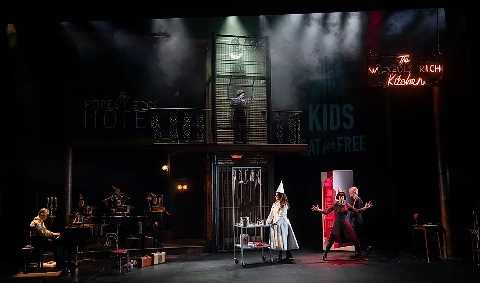
It's a fairy-tale so there's no requirement for realism in the Irish National Opera production created in collaboration with directors Muireann Ahern and Louis Lovett. Although it's possible to hint at contemporary concerns in Hansel and Gretel, there's no emphasis placed here on the idea of the two children living in poverty, victims of austerity cuts or even neglectful parenting. The family do appear to have lost their home here however, being forced to move around but somehow able to afford to stay at the Forest Edge Hotel, whose sinister appearance is enhanced by the notice that children are welcome.

It's the sinister that the INO production does well, much of it established in Jamie Vartan's superb set design, creating a space that is adaptable for touring but still maximises impact. It doesn't settle for the obvious fairy-tale or Gothic settings, but finds rather a seedy character in the neon signs, the old-fashioned font of the projected signs and notices with their subtle undercurrents of menace. That character is also established early with the use of an extra actor (Raymond Keane) in a silent role playing the part of the Night Watchman, a character who is part illusionist amusing the children with tricks, part Childcatcher from Chitty Chitty Bang Bang tempting them with sweets and treats, and part Sweeney Todd figure serving them up for the witch to bake into pies.


There's nothing too sinister here mind, nothing to scare the children in the audience. I'm sure they could take a little more of the thrill of horror in a fairy tale setting, but that's largely avoided which feels like it is to the detriment of the character of the original work. In its place the directors bring some knowing humour and a play up the rivalry, bossiness and naughtiness in the interaction between Hansel and Gretel, which works well and is entertainingly played by Raphaela Mangan and Amy Ní Fhearraigh, a little broadly pantomime in places but with some lovely details and reactions when called for.

It's also very much a stylised production in that way that sees the starving Hansel and Gretel clean and smartly dressed in grey outfits, the overall look more storybook than social realism. Even the orchestra and Richard Peirson, leading the seven-piece Irish National Orchestra ensemble from the piano, get in on the act wearing incongruous party-hats and taking up position to the stage rather than being confined to a pit, although their movements suggest that they may well have risen from a pit of a different kind. All of this is great, all very much in character of the production as a whole, but none of it seems to add up to a consistent worldview much less one that has anything to say about child poverty, child abuse or warnings of child abduction.

There's no reason why it ought to but it should at least relate to or be on a par with the power of children's imagination and storytelling that lies at the heart of the work. If you're going to jettison the traditional fairy-tale elements in depictions of the gingerbread house, the sandman, the dew fairy and the fourteen guardian angels, and offer stylised characters and projections in their place, it would be nice if it was in service of an alternative take on the story. The fairy-tale can sustain it and indeed its whole purpose is to carry subtext, so Hansel and Gretel surely merits a deeper exploration of its themes. So too does Humperdinck's music.


What we did get from the reduced orchestration was a clearer sense of the folk song melodies and the storytelling character of Humperdinck's compositions, but with the mainly piano-led accompaniment it was all very evenly paced, lacking in colour and variety and not really successful in conveying the different tones and textures that you get in the orchestral arrangements. The dramatic performances were fun, playing for humour more than horror, and the singing was marvellous from all the main performers, particularly the bright Raphaela Mangan and Amy Ní Fhearraigh as Hansel and Gretel.

The other roles were also well sung with plenty of character on the parts of Carolyn Dobbin as the witch, Emma Nash as the Dew Fairy and Sandman and Miriam Murphy as the mother. Only Ben McAteer's proven abilities felt under-exploited here as a rather nondescript father. As entertaining as it was, under-exploited was also the general impression of the production as a whole, looking and sounding marvellous, but lacking in the depth that is there to be found in this rich work.


Links: Irish National Opera

Monday, 26 October 2015

Massenet - Werther (ETO, 2015 - Buxton)


Jules Massenet - Werther

English Touring Opera, 2015

Iain Farrington, Oliver Platt, Ed Ballard, Carolyn Dobbin, Lauren Zolezzi, Michael Druiett, Jeffrey Stewart, Simon Wallfisch

English Touring Opera, Buxton - 18 October 2015

Unlike many of Massenet's operas, Werther, the composer's ode to German Romanticism doesn't necessarily have to appear terribly old-fashioned. Which means of course that it doesn't have to be set in Goethe's period (the original story written in 1774) or around the time of Massenet's writing of the opera in 1887. There's a powerful universality to its theme of extreme passions that dominate the French operas in the English Touring Opera's Autumn 2015 programme, and accordingly, performing the work in English, director Oliver Platt sets this version in small-town America in the 1950s. Far from updating the work however, it still feels horribly dated and old-fashioned.

In fact, the production takes away considerably from the Romantic allure of the work, losing the period distance with which we can regard the over-heated emotions and declarations. The ETO's production has nothing to offer in its place, the small-town setting rather making it all look rather dull and domestic. Charlotte's father may get away with wearing baggy corduroys, a cardigan and smoke a pipe, but it doesn't really help that the others all dress in a similar 'square' manner. The ladies wear bright summer frocks, Arthur returns home in a GI uniform and transforms into Stanley Kowalski after his marriage to Charlotte. The weedy Werther meanwhile wears a suit and glasses looking like the local nerd. It's not a good look for a romantic-hero opera archetype, however overwrought, oversensitive and neurotic he might in reality be.


A little bit more of Tennessee Williams wouldn't have gone amiss in this setting actually. It's functional for the suppression of violent passions, but it lacks the kind of moodiness and threat of underlying violence that is needed to ramp up the melodrama for Werther. Actually, a better model for this Werther would be the garish Technicolor melodramas of Douglas Sirk, but that wouldn't have fitted with the pared down arrangement of the work for piano, violin, cello and clarinet. With the musicians up on the stage in the background, Iain Farrington conducting from the piano, the understated delicacy of the playing at least matched the tone of the setting and the characterisation here in Oliver Platt's direction, but really, Werther doesn't benefit from understatement.

It doesn't need overstatement either - as Richard Eyre's overblown production for the Met demonstrated - but it needs the grand Romantic sweeps of Werther's love theme that surge up in those moments when he is with Charlotte, and take on an additional poignancy in his memory of them that becomes almost unbearable. Understatement is fine elsewhere, as it contrasts with the idealisation and the morbid inclinations of Werther that take on a gloomy and despairing weight and meaning of their own when detached from the reality.

Unfortunately Ed Ballard didn't give us a moody Romantic hero too sensitive to live in this cruel world without Charlotte. With the use of an English translation moreover - awkward scansion and not really any attempt to Americanise it - there was more of an air of petulance about this Werther. "Dash it all, this is very inconvenient!", was more the attitude that came across, Werther annoyed and mildly put-out that his plans to spend the rest of his life with Charlotte have run into the obstacle of Arthur's return. I don't think that Werther suited a baritone either. Jonas Kaufmann can certainly give the role the body and fullness of tone that approaches a baritone, but transposed this way it lacked the richness of colour and expression needed here.


There was strong singing from Lauren Zolezzi as a bright Sophie and Simon Wallfisch as Albert. Carolyn Dobbin as Charlotte and Ed Ballard were also fine, but the casting and the direction didn't do them any favours. They weren't able to bring any real conviction to their characters whose motivations and conflicts are much more important to the work as a whole. Werther is a work that requires a greater dynamic than this, and Massenet provides a strong musical equivalent to the Romantic heroism of the unlikely phenomenon created by Goethe. The English Touring Opera's production wasn't able to deliver that in its chamber arrangement or in the stage direction, and the actions consequently felt very old-fashioned, staged and remote from modern sensibilities. 

Monday, 9 February 2015

Strauss - Salome (NI Opera, 2015 - Belfast)

Richard Strauss - Salome

NI Opera, 2015

Nicholas Chalmers, Oliver Mears, Giselle Allen, Michael Colvin, Robert Hayward, Heather Shipp, Adrian Dwyer, Carolyn Dobbin, Paul Curievici, Nick Sales, David Lynn, Conor Breen, Cormac Lawlor, Brendan Collins, Padraic Rowan, Rory Musgrave, Hayley Chilvers

Grand Opera House, Belfast - 6 & 8 February 2015


The Grand Opera House in Belfast has never seen anything like it. Oh, I'm sure it has seen its fair share of Oscar Wilde plays, theatrical violence and gore, and even a little bit of nudity on occasion, but almost certainly never together. It's in opera terms however that Salome is a new experience for audiences at the Grand Opera House. The Belfast opera-goer has - in my experience at least over the last 25 years - never been subjected to an opera as intense, shocking and set to a production challenging to both delicate and not-so-delicate sensibilities as last weekend's Salome. That's testament to the ability of Strauss's opera to still have such an impact over 100 years after it was written, but it's also an indication of how NI Opera has been steadily upping the dose of less common but vital works to wean the audience away from the relatively safe fare of Mozart and the Italian bel canto repertoire.

It's ironic in this respect that the two most challenging opera works to appear on the stage of the Grand Opera House under NI Opera's brief term of office, have been adaptations of Oscar Wilde plays - Gerald Barry's The Importance of Being Earnest and Strauss's Salome. Who would have thought that Oscar Wilde's gently amusing late-Victorian domestic dramas could still be the source of so much shock and subversion? What both operas have in common is the ability to translate the genuine transgressive and subversive challenges to conventional social, family and sexual mores of Wilde's period into a more modern context where they still have impact and relevance. The relative rarity of performances of Wilde's dramas perhaps indicates that the nature of opera, with its timeless musical language, seems to be better placed to present Wilde on the stage nowadays than traditional theatre.


Particularly when you see it done in a performance like this. The key towards representing Richard Strauss's Salome on the stage has always been that of preserving the essential mood. Strauss's score (a challenge in itself) represents the florid decadence and dark sensual undercurrents of Wilde's play to perfection - and takes it further - but there's a risk of losing some of the seething Oriental lusts and the subversive religious flavour of the work if it is taken out of its Biblical context. I personally haven't seen any production of Salome that has risked straying too far from its original setting, so it's surprising and very daring of Oliver Mears to do so for a Belfast audience by setting it in what looks like the protected and security monitored estate of a drug baron or corrupt wealthy businessman in the deep American south.


What is more surprising is not only does the work lose not a fraction of its dark intensity, but by divorcing the work from its Biblical setting it actually reveals much more of the intent and hidden meaning of Oscar Wilde's original play. Which, it seems, when performed as well as it is here, can only enhance what Strauss brings to the work musically. A lot of the reason for it being quite so powerful, it has to be said, has to do with the performance of the Ulster Orchestra, its numbers boosted here to take on Strauss's huge orchestral arrangements, as well as the impressive direction of Nicholas Chalmers to channel and deliver those forces at the appropriate points with subtle but devastating impact. Even though Belfast received its first ever staging of a Wagner opera last year (The Flying Dutchman), it has rarely witnessed musical forces wielded so powerfully in a fully staged opera as in these two NI Opera performances of Salome.

And when I say fully-staged, that is vital to the impact of any opera, particularly when the music, the staging and the performance work hand-in-hand. If the revealing of a dark underbelly of American society with suggestions of abuse and incestuous relationships within the family unit inevitably brings to mind the films of David Lynch, director Oliver Mears nonetheless carefully avoids the Krzysztof Warlikowski route of direct movie cross-over references. Likewise, Mears wisely sidesteps any local religious context, even if NI Opera are not afraid to risk the wrath of religious fundamentalists in the province with their last-minute announcement of a "content change" to introduce a dancer appearing nude for ten seconds into the production. While that didn't produce any serious controversy this time, it did result in predictable outrage from a few rent-a-quote extremists, clearly unfamiliar with the work, unable to recognise the irony of accusations of introducing 'sensuality' into a Biblical story that centres on the Dance of the Seven Veils. In any event it would turn out that there was nothing in any dance that could be as controversial as a fully-clothed blood-soaked Salome writhing on top of the decapitated head of John the Baptist at the finale.

There were nonetheless a few murmurs of surprise from the outset when the curtain rose on Friday night to reveal a near full-sized house with a roof, on the heavily guarded and high-fenced compound. In the house, a rather sleazy-looking bulging-waisted, balding Herod with his wife Herodias, dressed in a jump suit and heels like a character out of Dallas or Dynasty, preside over a rowdy dinner party. Guarding a yellow cistern, from which the booming voice of the prophet emanates, stand a nervous group of guards wearing cowboy hats, some stripped to the waist, carrying rifles. Seen through a large window, the seediness of the dining room setting, where a pawed-over and harassed Salome looks wistfully out at the moon, is characterised brilliantly by the boorish behaviour of Herod's Jewish guests. As they settle down to watch a projected porno movie after the meal, outside the house Salome pours her lustful thoughts out to the frightful masculinity and shocking pronouncements of the imprisoned prophet Jokanaan.

What this brings out is not so much any imposition of modern sensibilities onto old Biblical material - although that is a valid aim, and one that does update the relevance of the play - as much as bring you right back to the source material and consider what Wilde was saying about the hypocrisy of society and religion, repression of illicit sexual desires, and the corrupting influence of dysfunctional family life. By making you think about how that relates to Wilde's own secret life and how that comes out in his works ("Each man kills the thing he loves..."), it's not so much taking the work back to Victorian times, as much as doing exactly what Strauss does with his musical interpretation of the work. It's delving far beneath the surface drama - as torrid, violent and twisted as it is - to the darker places that those repressed human impulses arise from. Salome oversteps the boundaries of what is deemed acceptable (by anyone's standards - but all the more so here for effect), and as such, she must die, condemned by the hypocritical authorities.

It was amazingly premonitory and daring of Wilde to write like this - right before his conviction for 'unconventional' sexual practices and his death soon after. NI Opera's setting of the work, Mears direction, and particularly the performances, explore all the facets and the resonances of the source, and bring it out meaningfully and magnificently without having to make any direct references. Salome ought to be shocking, still ought to take your breath away in its approach to its subject matter, and musically it should pretty much hammer you into submission, and that is entirely the impact achieved in the NI Opera production. To do that, it also needs singers of ability and sheer nerve to not only take on the challenges represented by the characters, but even to surpass the content and rise over the vast orchestral surges and cacophonic flourishes that make these characters and their dark desires convincing and horribly compelling.


As Salome, Belfast soprano Giselle Allen demonstrated why she is also a big name on the international opera circuit, her voice powerful enough to carry over that huge orchestral sound arising from the pit. It was a performance however that was, as it needs to be, sensitive to the changing moods, dipping softly but still able to be heard, rising to anger and violent expression and sustaining that for a large part of the unbroken one hour and forty-five minutes of the one-act performance. As well as managing this with barely a waver of pitch, strong at every register (in a role that is testing at every register), Allen also brought a degree of subtlety and conviction to the characterisation in her revulsion towards Herod and in her wild desires for Jokanaan, with recognition that there is a connection between those two states. Everything about this performance was mesmerising - you couldn't take your eyes off her for a second. If you haven't got a Salome like that, you haven't got a Salome.

Fortunately, the NI Opera production also had a prophet of immense charisma in Robert Hayward's Jokanaan. A terrifying presence, booming even from within the cistern tank, his appearance on the stage, dripping grime, gravely intoning dire warnings of the the coming of the Son of God and apocalyptic damnation for all the sinners present created a tremendous impression, Hayward's huge voice carrying utter conviction as well as fanaticism. Heather Shipp's Herodias and Michael Colvin's Herod had a little more of a challenge at times rising above the orchestra - and the translated English text didn't always make their parts scan quite as well (or match Wilde's poetry) - but the performances were well-sung and delightfully characterised. Paul Curievici's First Jew and Adrian Dwyer's Narraboth stood out from an overall very strong supporting cast. If there were many things that the Grand Opera House has never seen the like of before in NI Opera's scandalous production of Salome, perhaps the most satisfying is that of largely home-grown talent like this being given the opportunity to really show what they can do.